

1671 – All land of the vast and unknown interior of the continent was claimed as a French possession under military rule.
1763 – The land where Aviston stands switched hands from France to become part of the British Empire and territorial Virginia.
1810 – The first European settlements began to appear along the Sugar Creek. Native Americans offered occasional resistance, sometimes deadly, to the intrusion.
1812 – Nathaniel Journey sets up a log fort northwest of Aviston in township section 11 during the War of 1812 to protect settlements from British or Indian ruin.
1814 – On August 5th John Journey (Nathaniel’s brother) filed for Sugar Creek township section 11. One month later he died at Hill’s Fort near Greenville, Illinois during the War of 1812.
1814 – A local named Mrs. Bayels was killed by Native Americans while riding with her husband Jesse Bayels east of the Sugar Creek just off of what is today Old State Road.
1818 – Illinois becomes a state
1824 – On December 27th Clinton County was created out of Washington, Bond, and Fayette counties.
1830 – Samuel Hull, a Virginian, brought his money and trading skills to Illinois. He would ultimately own much of the land that was initially Hull and later became Aviston. Samuel Hull also donated the parcels where the Catholic Church was constructed.
1835 – Hugh Johnson, a Revolutionary War soldier, was buried in Sharon Cemetery just southwest of Aviston along Rocky Ford Road.
1836 – The Original Town of Aviston was laid out into lots on April 29, 1836 along what is now the Old State Road. Aviston was the first town established in Sugar Creek Township.
1836 – A compelling Founding Date for the Village, as it was on July 14, 1836 that President Andrew Jackson commissioned the Aviston Post Office and named Alexander Shields as inaugural Postmaster. The Aviston Post Office has run continuously ever since. Aviston is said to have been named after gunsmith John T. Avis, the first person to open a business in the community on the old Vincennes Road.
1840 – Between the years of 1840 and 1845 local Protestants built a small frame church in Aviston.
1850 – Aviston appears on the 1850 Illinois map.
1854 – In the 1850s the O & M Railroad was constructed and runs East-West through Clinton County. The rail line is nearly a mile south of the Original Town of Aviston, and a southward move of businesses and residents was underway.
1860 – The Village of Hull was laid out into lots by the J.W. Dugger and Co. and includes development along the O & M Railroad.
1861 – Residents in the Aviston area register and fight in the Civil War.
1862 – The Sacred Heart Hospital, a two-story frame structure, on lots 6 and 7, in block 22, was finished by Rev. F. Lohman at a cost of $6,524.00.
1864 – The cornerstone for St. Francis of Assisi Catholic Church was laid in the spring. The original 80 by 50 ft. structure was built by Gerhard Rolfmeyer and Henry Dillmann for $11,741.25.
1864 – Aviston’s First Lieutenant Robert Gooding fought for the 59th Infantry and died in the Battle of Nashville. He is buried in Lake Branch Cemetery just northeast of Aviston Park on Old State Road.
1865 – Aviston Civil War soldier’s like Jacob Hetzel, of the 13th Illinois Cavalry, return home from war. He received a $8.00 a month pension for serving his nation.
1865 – On November 22, 1865 Samuel Hull died and was buried several miles north of Aviston in Gullick Cemetery.
1870 – Clinton County’s population reached 16,285.
1875 – The Aviston we know today was once the combination of three communities, Aviston, Hull and Hecker.
1879 – St. Francis purchased four bells weighing 5,000, 3,300, 1,140, and 560 lbs. These were the largest ever cast in St. Louis at the time.
1880 – Henry Rosen was elected the first Village President in 1880. Early terms were only 1 year.
1884 – October 24th, 1884, Aviston was officially registered as a village with Illinois.
1887 – St. Francis completes an extensive expansion of the church. The upgrade cost the parish around $42,000 with a 185 feet tall steeple and a 820 seating capacity.
1895 – Population of Aviston was 381
1906 – Telephone service is introduced to Aviston
1907 – The Original Village Hall building was erected at the corner of Spring and 1st Street.
1909 – The first Aviston volunteer fire department was organized in May of 1909.
1913 – In 1913 commercial business begins to pick up.
1913 – Fred G. Brefeld was elected mayor and continued to serve until 1945. He served for a record 32 years as mayor.
1914 – Henry J. Althoff of Aviston was ordained the Diocese of Belleville’s 2nd Bishop. Althoff served as Bishop for 33 years.
1917 – Reverend Frederick Lohmann, 41 year pastor at St. Francis and visionary of the current building died on February 10th. Lohmann was buried near the cross at St. Francis Cemetery.
1918 – Pvt. Urban Mondt of Aviston died on September 28th, 1918 fighting in World War I. It was in the Meuse-Argonne Offensive, a major battle of World War I, that Urban died. This was one of the biggest operations and victories of the American Expeditionary Force (AEF) in that war. The offensive took place in the Verdu Sector, immediately north and northwest of the town of Verdun. He was put to rest in the Argonne American Military Cemetery in France. Mondt is recognized at the Aviston Post 1239 American Legion.
1921 – In 1921 Aviston built a large school (St. Francis Parish Center today). The school contained six first floor classes, a large auditorium upstairs, and a large basement for the cost of $54,480.
1921 – The 3,037 mile long U.S. Route 50 passes through Aviston, Illinois. “The backbone of America” runs from San Francisco, CA to Ocean City, MD. The history of Route 50 dates back earlier than the 1920s. 50 turns into Constitution Ave. which passes by our nation’s Capitol. Learn more about our highway from Wulf Berg.
1923 – Aviston High School District 71 was organized and it included Albers and Damiansville.
1929 – The Aviston Milling Company burns to the ground mysteriously.
1930 – The 1930 Aviston census listed residents within the village limits. The census shows 380 residents. The 1930 Sugar Creek census list residents outside the limits of Aviston and Trenton in Sugar Creek Township.
1937 – The upstairs auditorium (St. Francis Parish Center) was transformed into classrooms and a the gymnasium was built in 1937 for $20,000.
1940 – Census showed Aviston with 388 residents.
1941-1945 – Citizens of Aviston and Clinton County joined in the fight of World War II.
1945 – Sgt. Joseph F. Lampe fought in the 289th infantry and was one of 45 people from Clinton County killed in World War II. He died January 19, 1945 and his burial was in the Henri-Chapelle American Cemetery in Henri-Chapelle (near Liege), Belgium. At this cemetery, covering 57 acres, rests 7,989 American military dead, most of who gave their lives during the advance into Germany known as the Battle of the Bulge. Lampe is recognized at the Aviston Legion.
1947 – Aviston won the first of its three baseball district (high school regional tournaments) tournaments. The others came in ’51 & ’56.
1948 – In 1948, St. Rose, Germantown, and Bartelso were added to the Aviston High School District. This made Aviston the second largest school district in the state by land area.
1949 – The original Aviston water tower was erected. The 125′ tower holds 30,000 gallons of water and cost $15,700.
1952 – Fred Lohmann was elected mayor and continued to serve until 1977. He served as village president for 25 years.
1956 – A tornado struck the St. Francis Church and damaged the tower. A much shorter steeple tower replaced the old one.
1958 – Mater Dei Catholic High School was established in 1958 when AHS enrollment was at 250 students. Local priests and the Bishop recommended students attend Mater Dei and this dramatically hurt the school district.
1959 – Aviston builds a sewer system for residents within the village limits
1962 – A group of Aviston civic leaders made preparations for a Founder’s Day Celebration and chose 1964 as the Centennial date in commemoration of the laying of the Church’s cornerstone in 1864. It also gave the group a couple of years to plan.
1964 – Aviston celebrated its 100th birthday with a Centennial celebration and parade.
1967 – Aviston purchased land east of town and begins work on a new community park.
1969 – President Eisenhower’s funeral train travels through Aviston.
1970 – On July 1, 1970 Aviston High School and Breese Community High School voted to consolidate into Central Community High School, District 71.
1980 – Census showed Aviston with 846 residents
1989 – Aviston celebrated 125 years. The Quasquicentennial celebration was held at the park.
1989 – Charles Rakers was elected mayor and served until 2009.
1990 – Census shows Aviston with 924 residents.
1996 – The Aviston Village Board approves the incorporation of land north of new Highway US 50.
2000 – Census showed Aviston with 1,231 residents.
2000 – The late 1900s and early 2000s were a good time for residential growth in Aviston. Aviston has became one of the fastest growing small communities in the state of Illinois. From 1990 to 2000 Aviston’s population grew 33.2%.
2001 – On October 9th, 2001, Aviston Elementary moved from Spring Street to Hull Street. The building cost an estimated $5 million.
2003 – Aviston purchased 24 acres of land east of the village community park. Soccer and football practice fields have been made out of this addition.
Also, the Volunteer Fire Department completed construction on a new firehouse on Railroad Street.
2003 – The Village of Aviston published its Web site.
2004 – The Aviston Community Park District was created by ballot initiative by a vote of 145-67 on March 16th. The boundary of the district matches that of the School District voters, except citizens in Madison County.
2005 – On June 4th, 2005, Kopff Park was dedicated to Fr. Herbert Kopff who was instrumental starting the Khoury League in Clinton County. A brick memorial sits behind home plate to recognize the occasion. Fr. Kopff died shortly after the dedication on August 15, 2005.
2006 – Aviston passed another school referendum with 62% yes vote to add on to the elementary school.
2007 – Aviston Elementary added on a storage facility, six classrooms on the west wing, and made other smaller improvements to the school. The additions were made on the western side of the campus. Construction began on May 7th, 2007 and students entered the new section on Oct. 28th, 2007.
2014 – Aviston celebrated its 150th Birthday, known as the Aviston 150, with an epic 3-day party at the Village Park.
2015 – The Inaugural Aviston Olympics is held at the Park, with yard games and live music and friendly competition. All organized by the ACIC.
2016 – On April 25th, work begins on repurposing the 1907 Original Village Hall into a true Community space using proceeds from the Aviston 150. Work is on-going. The ACIC membership joins in to lend time, exceptional talent and financial resources to the project as well.
2017 – The ACIC organizes Aviston’s Zip Code Day street party (6-22-16) on the grounds of the Original Village Hall, featuring Hot Dog Eating, a Food Truck, and The Beer Mile street race.
2017 – Aviston breaks ground for a new 300,000 gallon water tower to replace the 30,000 gallon tank erected in 1949.
- Aviston is positioned 38.60 degrees north of the equator and 89.60 degrees west of the prime meridian.
- Mayor of Aviston is Dale Haukap (2012-Present).
Historical Buildings in Aviston
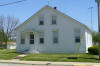
The (1850s?) Hull house was built before the Village of Hull was platted in 1860, but the exact year of construction is still a mystery. This was the residence of George W. Hull and was part of the plans laid out by H.C. Neal. George was given the land from Hull’s founder, Samuel Hull. The building was a grocery store and a post office for some time. This home was awarded a Clinton Co. Historical Society historical plaque in 1979. It is currently owned by Kurt and Jackie Schmitz.

The 1898 original Twiss home built prior to the Twiss Victorian home pictured below. This home was awarded a Clinton Co. Historical Society historical plaque in 2006. Kurt and Jackie Schmitz currently own the home.

The 1908 Twiss historic Victorian home now owned by the Moon family.
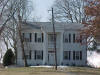
Home of Sharon and Jerry Lampe believed to have been built in 1870.
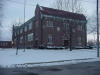
St. Francis Parish Center built in 1921.
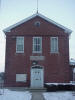
Aviston’s “old” village hall built in 1907.

St. Francis Church built in 1864.